

A no-fluff comparison of features, AI capabilities, pricing, and ideal use cases across the three leading document rights management platforms.
The market for document rights management software hasn't meaningfully changed in years — until now. The arrival of AI as a daily productivity tool has exposed a structural gap in how most DRM platforms were built: they can lock a document down, but they can't help anyone work with it intelligently. This comparison examines how DocuAssist.AI, FileOpen, and EditionGuard differ across the dimensions that matter most in 2026.
DocuAssist.AI
AI-Native DRM
Built from the ground up for organizations that need AI-powered document intelligence without sacrificing security controls.
From $49/mo · Free trial
FileOpen
Enterprise PDF DRM
A 27-year-old platform offering deep PDF and Office security with strong access controls and cross-platform support.
From $1,750/yr · Quote-based
EditionGuard
eBook Publisher DRM
Adobe Content Server delivered as a hosted service, built specifically for independent eBook publishers and authors.
From $49/mo · Free trial
Head-to-Head Feature Comparison
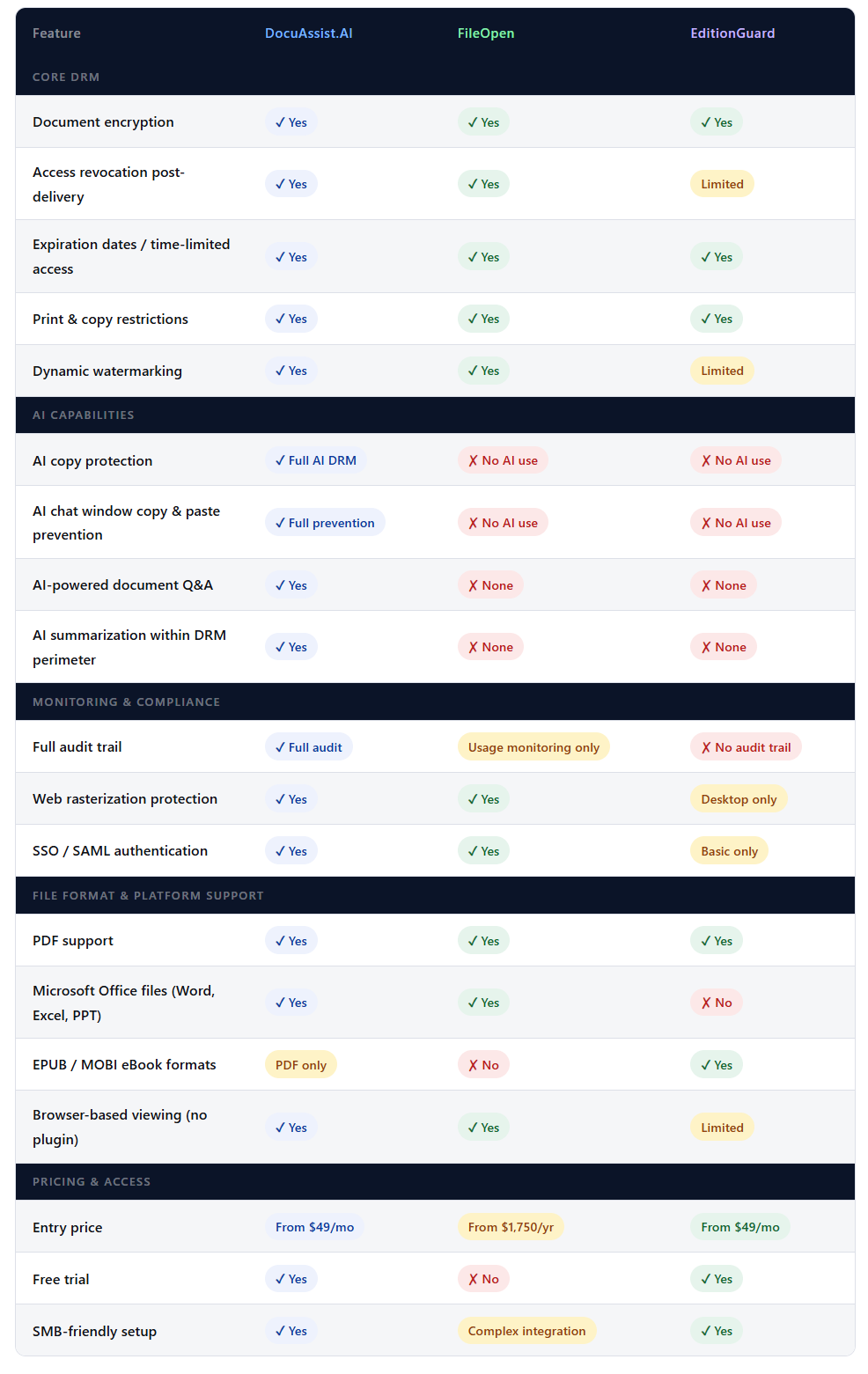
The table below covers the features that most enterprises and publishers ask about when evaluating DRM software. AI-related capabilities are highlighted separately — they represent the sharpest dividing line between modern and legacy platforms.
Overall Scores
Scored across five dimensions: core DRM strength, AI capability, compliance depth, ease of setup, and value for money.

Pros & Cons: Platform by Platform
DocuAssist.AI
Strengths
- Only platform with AI operating inside the DRM perimeter — no content leaves the security envelope.
- Actively prevents content being copied into external AI chat windows.
- Full audit trail covering both human and AI interactions.
- Web rasterization protection works across browsers, not just desktop
- Dynamic watermarking that survives screenshotting
- SMB-friendly pricing with a free trial — no procurement process required
- Built on PCI DSS-certified and SOC 2-compliant infrastructure
Limitations
- Newer platform — smaller track record than FileOpen's 27-year history
- EPUB / MOBI eBook format support not yet available (PDF and Office focus)
- Integration ecosystem still maturing compared to established vendors
- Best suited to business documents — not designed for consumer eBook retail
FileOpen
Strengths
- 27 years of DRM experience — proven in publishing, finance, government, and legal sectors
- Granular, persistent access controls across PDF and Office formats
- Password-free authentication via SSO, SAML, email, device, or domain
- Access revocation even after document delivery
- Strong cross-platform compatibility including mobile (iOS/Android)
- Browser-based viewing without requiring plugin installation
Limitations
- Zero AI capability — treats AI as an external threat, not an integrated tool
- Audit trail covers usage monitoring only, not a full interaction log
- Entry price of $1,750/year is prohibitive for smaller teams
- No free trial — requires a sales conversation before testing
- Complex integration process — not suited to rapid or self-serve deployment
- No standalone Windows/macOS desktop app
EditionGuard
Strengths
- Adobe Content Server delivered as an affordable hosted service — removes expensive licensing burden
- Supports Adobe DRM, Readium LCP, and Social DRM — broadest eBook format coverage
- EPUB, MOBI, and PDF support makes it the go-to for independent publishers
- Built-in storefront with payment processing and automated eBook delivery
- Easy WordPress, Shopify, and Magento integrations
- Affordable entry pricing with a free trial
Limitations
- No AI capability of any kind
- No audit trail — activity monitoring only covers downloads and fulfillment
- Web rasterization protection is desktop-only — browser-based viewing is limited
- Designed exclusively for eBook publishing — not suited to enterprise document workflows
- Device-locking can frustrate end users on multiple devices
- Relies heavily on Adobe's licensing ecosystem — less flexibility for non-Adobe readers
The AI gap is structural, not a roadmap item. FileOpen and EditionGuard were architected before AI assistants became a daily workflow tool. Adding AI capability to their platforms would require rebuilding the document interaction layer — it cannot be bolted on. Organizations that want AI and DRM in the same environment today have one realistic option.
Who Should Use Which Platform?
DocuAssist.AI (Best for Most Teams & Large Publishers)
Publishers, enterprises, law firms, consultancies, and financial institutions that need more than DRM — combining AI-powered document intelligence, secure collaboration, controlled sharing, and advanced document protection in a single platform.
FileOpen (Best for Traditional DRM Publishing)
Organizations focused primarily on DRM-protected PDF distribution, including standards bodies, government agencies, and publishers with established document delivery workflows.
EditionGuard (Best for eBook authors)
Independent authors, small publishers, and course creators who need affordable Adobe DRM for EPUB/MOBI distribution with built-in storefront capability.
The Question Every Buyer Should Ask
Most DRM evaluations focus on what a platform prevents: unauthorized copying, redistribution, screenshot capture. These are table stakes in 2026 — all three platforms address them to varying degrees.
The question that separates modern DRM from legacy DRM is: what does your platform allow authorized users to do? If the answer is "read the document and nothing else," you are managing documents like it is 2010. Your people need to extract meaning, generate summaries, compare versions, and feed insights into decision-making — and they will find a way to use AI to do that whether your DRM policy permits it or not.
When they do it outside your DRM perimeter, your security controls are meaningless. The document content that enters an external AI chat window is untracked, unencrypted, and unrevocable. No watermark survives it. No audit trail records it.
DocuAssist.AI is the only platform in this comparison that treats this as a design problem rather than a policy problem — building AI capability inside the security envelope so that the answer to "what can authorized users do?" is "everything they need to, securely."